One of the most outstanding finds on Fayaztepa, discovered in 1968, was the Triada composition depicting…


The 1960s entered history as a time of “thaw” and were an interesting epoch in the history of Uzbek art. Interest in Uzbekistan’s own culture, history, and people’s lives grew and deepened, revealing features of universal and international values in national art.
This period in the history of Uzbekistan art could be referred to as the period of national romanticism. During this time a new impetus was gained by genre and historical painting, portraiture, and still life. The paintings of this generation reflect not only specific historical facts and life phenomena but also their philosophical understanding. The pictorial palette of this period is rich and varied, the artistic images are filled with associations and metaphors. The focus shifted from “what” was depicted to “how” it was depicted.
The previously unified method of reflecting reality, so-called socialist realism, was replaced by the artist’s worldview and individuality. Painting then incorporated color, form, and texture, while images were infused with expression and romance. Having mastered the stylistics based on the tradition of Russian and Soviet art, the Uzbek artists of the 1960s generation did not simply adopt the widespread “severe style”. Instead, in their creative pursuits they synthesized their national originality with the tradition of European post-impressionism and the painting of the Turkestan avant-garde of the 1920s–1930s.
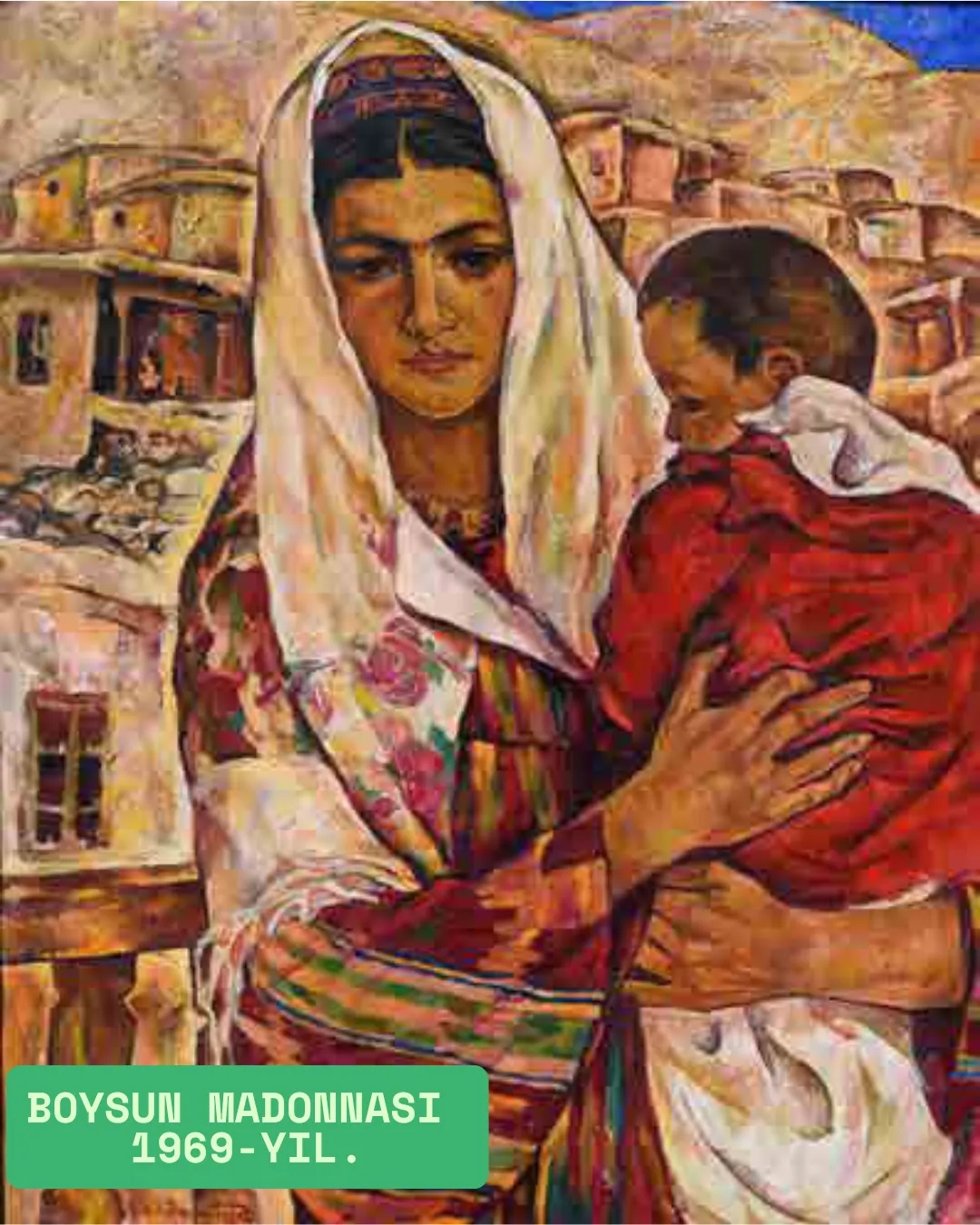
The collection from this period is diverse and includes works that became significant for this era, such as “Baisun Madonna” by V. Burmakin, “Kumkurgan Apples” by R. Charyev and his portraits of contemporaries, including the “Old Man from Sayrob”, “Samarkand ceramist Kh. Hakberdiyev”; oriental still lifes by E. Melnikov and his romantic landscapes of Aktash and Sukok; “Street of Old Bukhara” by Y. Taldykin and his colorful still lifes; “May in Baisun”, “Farewell to Summer”, “The Generous Land of Uzbekistan” by G. Zilberman; “Portrait of Ata Palvanov” by A. Perov and others.